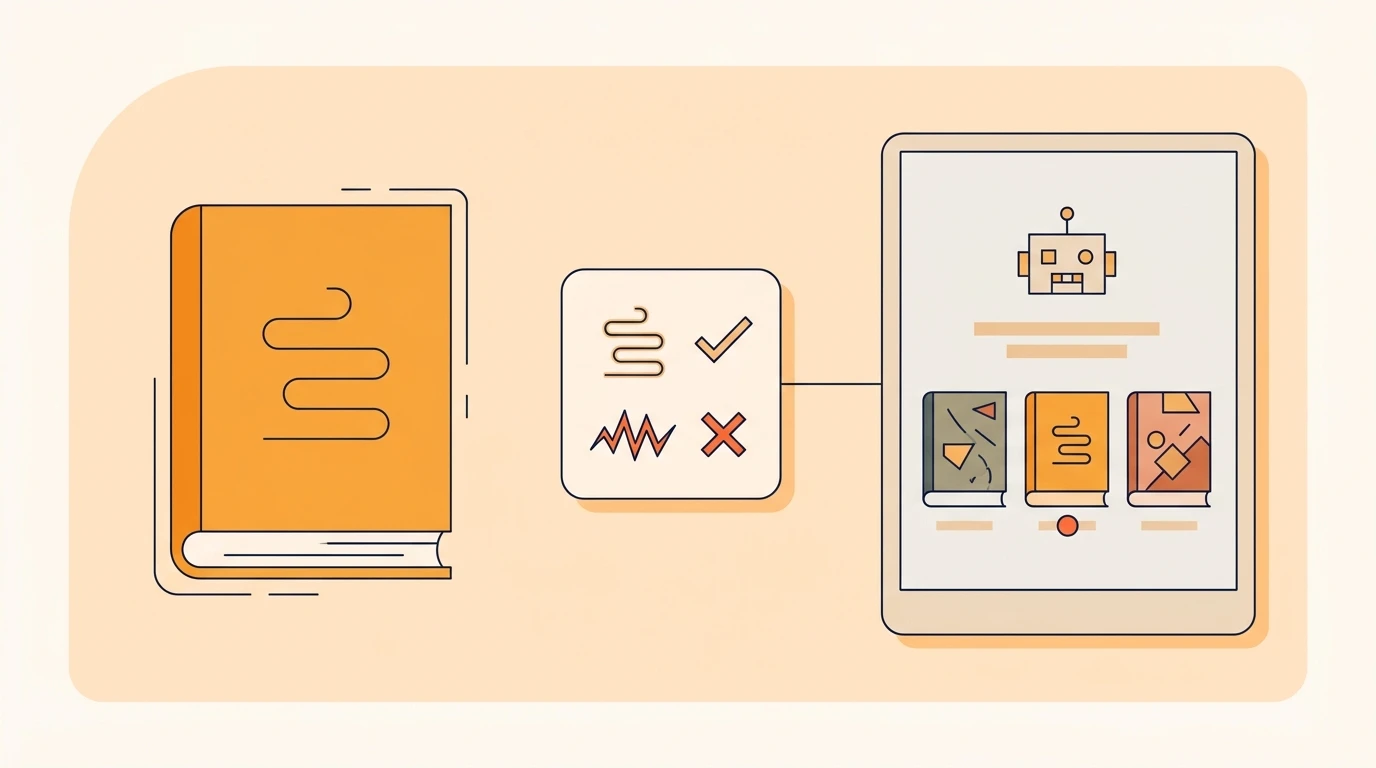
AI Book Recommendations: Choosing What to Read Next
What worked: The tension between political ideals and how people actually live. What I want next: Reflective science fiction with moral uncertainty. What I want to avoid: A plot driven mainly by battles. Reading goal: Pleasure and something worth discussing. Spoilers: None.
Recommend three books. For each, give the exact title and author, explain the fit, and name one reason I might dislike it.
Include one close match and one less obvious choice. Label uncertain details. Do not invent titles or quotations.
If a missing preference would change your choices, ask me before recommending. </code></pre>
<p>The dislike matters. It gives the system a way to reject an otherwise plausible match, especially when books share a genre but offer very different reading experiences.</p> <p>For your own request, replace the details in this reusable version:</p> <pre><code class="language-text">Books I liked: [Title and author, followed by what worked for me]Books I disliked or stopped reading: [Title and author, followed by what did not work]
What I want next: [Subject, mood, pace, style, or learning question]
Constraints: [Reading difficulty, language, format, or content boundaries]
Recommend a short list. For each book, provide: Exact title and author The strongest connection to my preferences A meaningful difference from my past reads A reason I might stop reading it Any uncertainty in your description
Avoid spoilers. Ask a clarifying question if my preferences conflict. </code></pre>
<p>For book recommendations based on other books, explain whether you want similar subject matter or a similar experience. Someone who loved a demanding novel may want another difficult book, or may want the same emotional intensity in simpler prose.</p> <p>We recommend asking the system to <strong>challenge one assumption in your brief</strong>. “You liked the ideas, but did you enjoy the slow pace?” is a useful question. Agreement alone leaves that ambiguity unresolved.</p> <h2>Check each recommendation before committing</h2> <p><img src="https://uuebignmwmogxyibupmz.supabase.co/storage/v1/object/public/article-images/bd578348bb7b66d2/ai/a-matching-catalog-entry-confirms-d362be.webp" alt="A matching catalog entry confirms the book exists, while a magnified sample helps check the recommendation’s fit."></p> <p>A credible recommendation has two separate jobs: identify a real book and explain why it fits you. A correct title can still come with a misleading description.</p> <p>Look up the title and author in <a href="https://search.worldcat.org/">WorldCat’s library catalog</a>, then compare the recommendation with the publisher’s description or the book itself. For nonfiction, check the edition when revisions could affect the material you need.</p> <p>Next, inspect the claimed connection. A suggestion such as George Orwell’s <em>1984</em> after <em>The Dispossessed</em> has an obvious link through political power, but that connection alone tells you little about whether you will enjoy its atmosphere or narrative approach.</p> <p><strong>Ask what differs as well as what matches.</strong> A useful explanation might warn that the suggested book is more oppressive in tone or more focused on suspense than the qualities you requested.</p> <p>Read a sample before accepting claims about style. For an accessible example, <a href="https://www.gutenberg.org/ebooks/84">Mary Shelley’s <em>Frankenstein</em> on Project Gutenberg</a> lets you inspect the opening letters directly, rather than relying on a broad description such as “fast-paced horror.”</p> <p>If the shortlist disappoints, revise one part of the brief instead of requesting an entirely new pile of titles. “Keep the moral uncertainty, but choose a more direct writing style” gives the next attempt a clear correction.</p> <p>This is also how you get more specific book recommendations without endlessly narrowing the genre. Change the quality that failed.</p> <h2>Choose a book that advances your understanding</h2> <p>For independent learning, your next book should address a gap you can name. Enjoying the previous book is useful context, but it does not establish what you need to understand next.</p> <p>Try a question such as, “I can describe the author’s argument, but I cannot explain the strongest objection. Recommend a book that develops that objection, and identify the background knowledge it assumes.”</p> <p>That request gives the recommendation a purpose. An <a href="https://learn.ipog.pro/blog/what-is-an-ai-tutor-and-how-does-it-teach-2">AI tutor’s role in testing understanding</a> also helps you distinguish a missing explanation from a missing reading assignment.</p> <p>If unfamiliar terms keep blocking you, ask which concepts a candidate book assumes you already know. Keep a short personal glossary with definitions in your own words, so the next recommendation builds on usable knowledge.</p> <p>When your starting point is a paper or chapter, <a href="https://learn.ipog.pro/blog/how-to-study-with-ai-using-your-own-source-material-2">studying with your own source material</a> gives the request a defined reference point. Ask for a book that explains a specific missing concept or presents a serious counterargument.</p> <p>We favor this approach over automatically choosing something harder. Difficulty earns its place when it helps answer your question.</p> <h2>Frequently Asked Questions</h2> <p><strong>Can AI recommend books from a photo of my bookshelf?</strong></p> <p>An image-capable tool can use visible book spines as input, but obscured titles may be misread. Confirm the extracted titles and explain which books you actually enjoyed, since ownership does not establish preference.</p> <p><strong>Do I need to upload my entire reading history?</strong></p> <p>No. A small selection with clear reasons can give the system more useful direction than a long list without explanation. Leave out private annotations or personal information that the recommendation does not require.</p> <p><strong>Can AI tell me which books are popular right now?</strong></p> <p>Only a tool with access to current information can check current popularity reliably. Ask it to identify the dated bestseller list or other source it used, since popularity and personal fit answer different questions.</p> <p>Use the Le Guin brief as your starting point: replace the title and explain the quality you want to keep. If you want recommendations alongside deeper study, The Depth Engine includes Ask the librarian with its tutor, and you can <a href="https://learn.ipog.pro/pricing">check the plans</a> before choosing that route. Run your brief, then read a sample of the strongest match.</p>Key Takeaways
- ◆Describe the quality you want to repeat, such as an unreliable narrator or an argument that challenges your assumptions.
- ◆Ask for a short list with a reason each book fits and a reason you might dislike it.
- ◆Verify the title and author in a library catalog. Read a sample to check the claimed fit.
- ◆For learning, specify the question your next book should help you answer.