How to Study With AI Using Your Own Source Material
Source label: [document title or short label] Section to study: [heading, printed page range, or pasted excerpt] Learning goal: [what I want to explain or apply without looking]
Use the supplied source as the authority for questions about what the author says.
Before teaching: Confirm which section you can access. Quote a short passage from that section so I can check access. Flag unreadable text or missing context.
During study: Ask one question at a time and wait for my answer. Begin with the meaning of a key claim. Then test its reasoning or application, where the source allows. If my answer is weak, give a small hint before explaining. Correct errors directly. Do not praise an answer that the source does not support.
During feedback: Identify what is correct and what needs correction. Give a short supporting quotation and its location. Do not invent quotations or page numbers. If page numbering is unclear, use a heading and quoted passage. Say when the source does not provide enough information. Label any outside knowledge separately.
At the end: Identify my unresolved misunderstanding. Ask me to explain it again without looking at the source. </code></pre>
<p>A summary can help you find the section to study. Keep it separate from the test of understanding: reading a polished explanation does not show that you can produce one.</p> <h2>Work through a passage before trusting the method</h2> <p>A complete practice cycle includes a question, your attempt, and feedback tied to the text. The correction should expose the reasoning error precisely enough that you can try again.</p> <p>Use this short practice passage, written for this example:</p> <pre><code class="language-text">Source label: Logic excerpt Location: DefinitionsAn argument is deductively valid when its conclusion cannot be false if all its premises are true.
A sound argument is valid and has true premises.
Validity alone does not establish whether the premises are true. </code></pre>
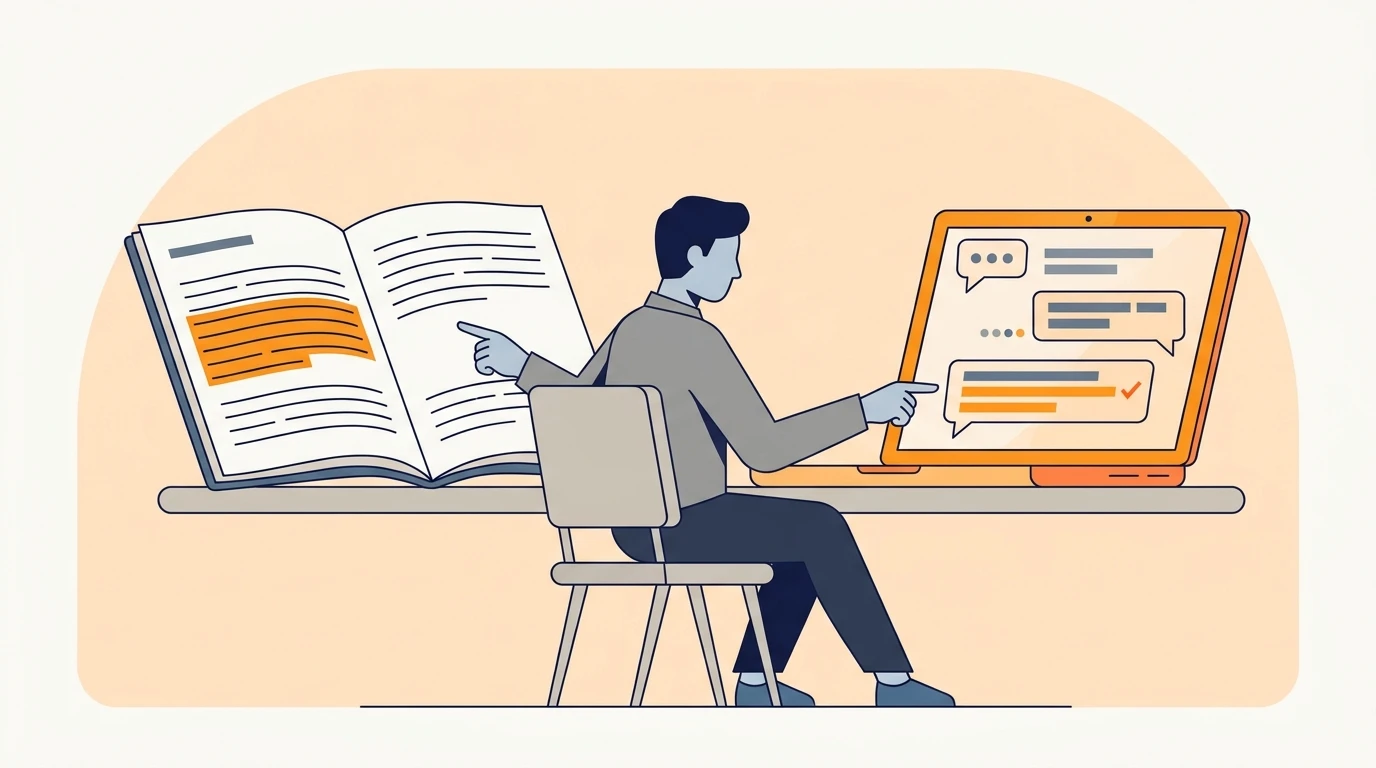
<p>Ask the tutor to test whether you can distinguish validity from soundness. A useful exchange would look like this:</p> <table> <thead> <tr> <th>Stage</th> <th>Example</th> </tr> </thead> <tbody><tr> <td>Tutor question</td> <td>Consider this argument: All birds are mammals. All robins are birds. Therefore, all robins are mammals. Is it valid? Is it sound? Explain using the definitions.</td> </tr> <tr> <td>Learner attempt</td> <td>It is invalid because birds are not mammals.</td> </tr> <tr> <td>Source-based correction</td> <td>You correctly identified a false premise. The argument is still valid because the conclusion must follow if the premises are assumed true. It is unsound because a sound argument must also have true premises.</td> </tr> <tr> <td>Supporting passage</td> <td>“Validity alone does not establish whether the premises are true.” Location: Definitions.</td> </tr> <tr> <td>Retry</td> <td>Explain why a false premise can make this argument unsound without making it invalid.</td> </tr> </tbody></table> <p>The correction has a boundary. The passage supplies the definitions, while identifying birds as non-mammals uses outside biological knowledge. A careful tutor should label that distinction rather than imply that every part of its feedback came from the excerpt.</p> <p><strong>Look for a correction you can act on.</strong> “Good effort, think again” leaves the misunderstanding untouched. Here, the exact mistake is using premise truth to judge logical validity.</p> <h2>Check the feedback against the original</h2> <p>Source-grounded feedback still needs checking. The <a href="https://doi.org/10.6028/NIST.AI.600-1">NIST Generative AI Profile</a> identifies confabulation as a risk, including confidently presented false content.</p> <p>Open the cited location and check whether the quotation exists. Then read the surrounding passage to see whether it supports the tutor’s interpretation. A quotation can be accurate while the conclusion attached to it is wrong.</p> <p>Watch for scope changes. If an author says a method works under stated conditions, feedback that drops those conditions changes the claim. Ask the tutor to preserve the qualification and explain why it matters.</p> <p>Page references need care too. A PDF viewer’s page count may differ from the printed page numbers inside the document. Ask which numbering system the tutor is using, or require a heading plus a short quotation instead.</p> <p>Keep <strong>source accuracy</strong> separate from <strong>factual accuracy</strong>. A tutor can faithfully explain an outdated source. First establish what the author claims, then request a separately labelled fact-check if your learning goal requires current knowledge.</p> <p>If the tutor cannot locate evidence, return to the passage yourself or paste the relevant section. Asking it to sound more certain will not repair missing evidence.</p> <h2>Turn corrections into recall and reflection</h2> <p>Retrieval practice means trying to recall material without looking at it. In their Science study, Jeffrey Karpicke and Janell Blunt found that <a href="https://www.science.org/doi/10.1126/science.1199327">retrieval practice improved learning from science texts</a> compared with elaborative study using concept maps.</p> <p>Close the source and explain the distinction between validity and soundness in your own words. Then construct a different valid argument with a false premise. Reopen the passage only after committing to an answer.</p> <p>Save terms you repeatedly confuse in a personal glossary. A useful entry contains your own definition and the mistake it helps you catch. For validity, keep the false-premise argument beside the definition rather than saving a bare dictionary sentence.</p> <p>Reflection should extend the concept into your thinking. Write about an argument you accepted because its premises sounded plausible, then examine whether its conclusion actually followed. Label this as your application, separate from the source author’s claims.</p> <h2>Frequently Asked Questions</h2> <p><strong>Can I use free AI study tools with my own PDFs?</strong></p> <p>Yes, if the tool’s current free plan supports your file format and enough follow-up messages for the exercise. Check its upload and usage limits before starting. If you are comparing options, the guide to <a href="https://learn.ipog.pro/blog/brainly-ai-tutor-alternatives-for-independent-study-2">Brainly AI Tutor alternatives for independent study</a> provides a starting point, but verify current limits with each provider.</p> <p><strong>Can I study several PDFs in the same conversation?</strong></p> <p>Yes, provided the tool supports them, but give each document a distinct label and require source-specific references. When comparing authors, ask the tutor to explain each position separately before comparing them. Otherwise, it may blend incompatible definitions into an answer neither author supports.</p> <p><strong>Is it safe to upload a private document?</strong></p> <p>That depends on the provider’s data policies and your permission to share the material. Check its retention and model-training terms before uploading sensitive content. Redact personal information, and use only material you are authorised to share.</p> <p>Use the validity passage to test the workflow, then repeat it with a difficult section from your own reading. The Depth Engine supports PDF and text uploads alongside a personal glossary, so you can keep unfamiliar terms connected to your study. <a href="https://learn.ipog.pro/pricing">Check our plans for source-based study</a> if that fits your needs, and begin with a passage whose evidence you can check yourself.</p>Key Takeaways
- ◆Give the tutor a readable section with a clear source label. Check that it can retrieve the text before trusting its questions.
- ◆Separate what the source states from what the AI infers. Require a supporting passage when it corrects you.
- ◆Answer with the source closed, then reopen it to check your reasoning. Save unfamiliar terms alongside the mistakes they help you avoid.