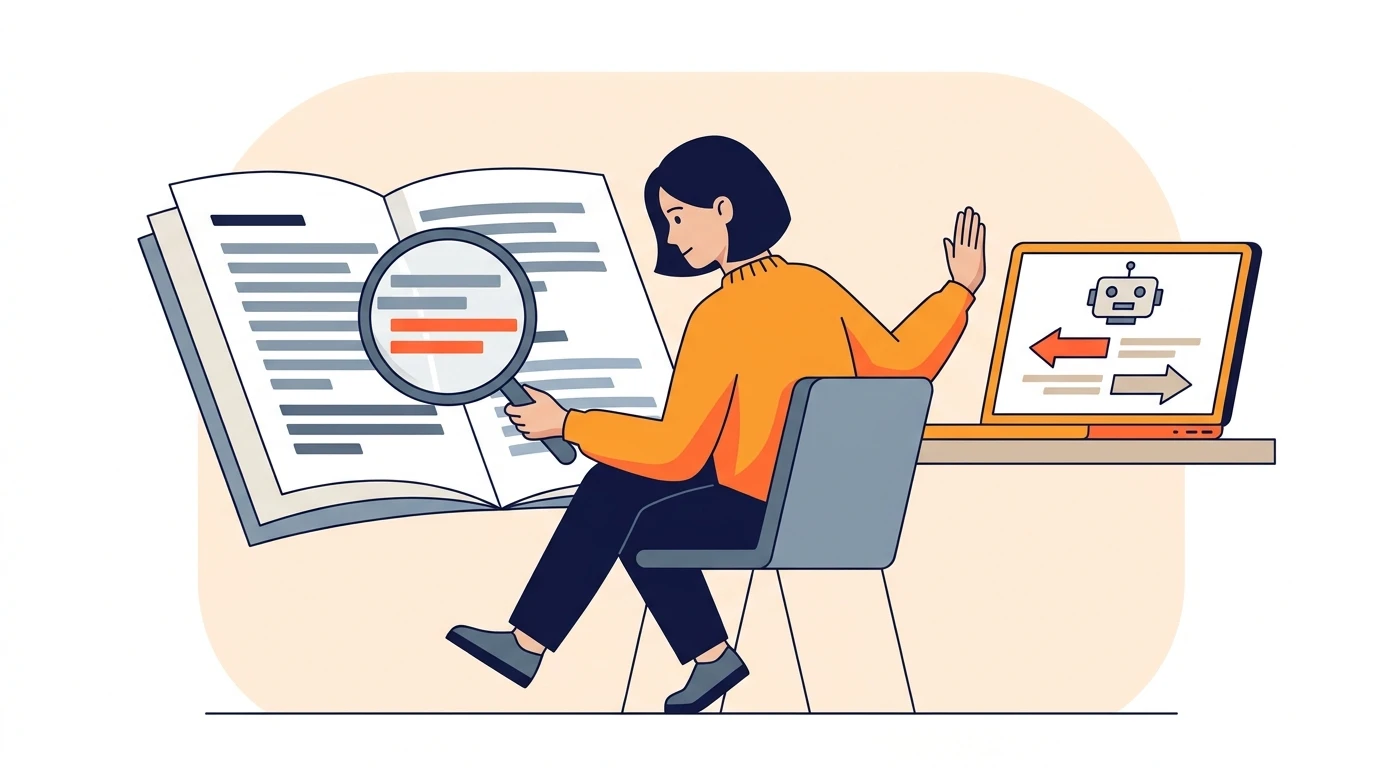
Critical Thinking in the Age of AI Requires Pushback
My provisional claim: [State what you think the passage establishes.]
My reason: [Identify the wording or evidence supporting your claim.]
Act as a demanding tutor.
Ask me to define any term whose meaning could change my claim. Separate what the passage explicitly states from what I have inferred. Identify the strongest objection supported by the available evidence. Quote the wording that supports your objection. If the passage does not support an objection, say so. Do not invent quotations, references, or page numbers. Label anything that requires checking outside this passage. Ask me to revise my claim before you offer your own final version. </code></pre>
<p>Treat quotations in the response as items to check. If you supplied only an excerpt, a missing detail may exist elsewhere in the document. <strong>“Absent from this passage” does not mean “absent from the study.”</strong></p> <h2>Worked Example: Challenge a PDF’s Conclusion</h2> <p>Suppose your course PDF describes students who chose an optional study workshop and later earned higher grades than students who did not attend. The excerpt does not describe random assignment or report earlier grades.</p> <p>You ask an AI tutor what the finding means. It offers this possible answer: “The workshop improved performance, so schools should require attendance.”</p> <p>That answer crosses several evidence boundaries.</p> <table> <thead> <tr> <th>What the passage reports</th> <th>What the answer adds</th> <th>Your pushback</th> </tr> </thead> <tbody><tr> <td>Attendees earned higher grades</td> <td>Attendance caused the difference</td> <td>Could students who attended already have been more motivated or better prepared?</td> </tr> <tr> <td>Students chose to attend</td> <td>Compulsory attendance would produce the same benefit</td> <td>What supports applying this finding to students who would not choose the workshop?</td> </tr> <tr> <td>The outcome was grades</td> <td>The workshop improved understanding</td> <td>What did the assessment measure, and does the passage discuss that?</td> </tr> </tbody></table> <p>The first challenge concerns <strong>self-selection</strong>. Students chose their group, so differences between the groups might help explain the outcome. That possibility weakens the causal conclusion, although it does not establish that the workshop had no effect.</p> <p>The second challenge concerns application. Even a useful voluntary workshop may work differently when attendance becomes compulsory. The recommendation needs evidence beyond the reported comparison.</p> <p>A defensible revised verdict would read:</p> <pre><code class="language-text">The passage reports an association between voluntary workshop attendance and higher grades. It does not establish that attendance caused the difference or that compulsory attendance would produce the same result.Before recommending compulsory attendance, I would check how students were assigned to groups and whether earlier achievement was considered. </code></pre>
<p>You have made progress if you can explain why the revision is narrower. Merely replacing your sentence with the tutor's better wording leaves the reasoning untested.</p> <h2>Check Whether the Challenge Improved Your Thinking</h2> <p>The practical test is whether you can use the reasoning after the answer disappears. Close the chat and explain why the workshop finding leaves room for self-selection. Then apply the same concern to a different voluntary activity, such as an optional reading group.</p> <p>Struggling to transfer the idea exposes a useful gap. You may recognise the term without knowing when it applies. Reopen the source to resolve that gap, then attempt the explanation again without copying.</p> <p>For unfamiliar terms, build a glossary entry with a definition and a boundary. For <em>self-selection</em>, the boundary matters: the term applies when people choose participation, rather than whenever two groups differ. Include an example where it applies and one where it does not.</p> <p>Connect the reasoning to your own decisions, too. A journal entry might ask whether you joined a study activity because you were already motivated, and what that means for judging its benefit. Keep that reflection separate from the study's evidence. Your experience can generate a question without settling the research claim.</p> <h2>Frequently Asked Questions</h2> <p><strong>Should you avoid AI when learning a new subject?</strong></p> <p>Begin with enough direct reading to recognise the subject's basic terms and central question. You can then use AI to probe specific gaps, while keeping unassisted attempts in your routine so you can see what you actually understand.</p> <p><strong>Can you cite an AI-generated reference in an essay?</strong></p> <p>Cite the original source only after finding it and checking that it supports your claim. Follow your institution's rules for disclosing AI assistance, which is a separate issue from citing the underlying evidence.</p> <p><strong>How can teachers assess critical thinking when students use AI?</strong></p> <p>Ask students to submit an initial judgment, explain a consequential revision, and defend the final claim in their own words. A follow-up using a changed scenario helps reveal whether they understand the reasoning beyond the submitted wording.</p> <p>Use the workshop example as a test for your next PDF: separate the reported result from the action someone wants it to justify. For source-based practice with The Depth Engine's AI tutor, <a href="https://learn.ipog.pro/pricing">check the plans</a> and <a href="https://learn.ipog.pro/auth">begin a study thread</a> using your own PDF or text. Keep your first verdict beside your revision so you can explain exactly what changed.</p>Key Takeaways
- ◆Write your own provisional answer before asking AI. You need a position you can compare with its response.
- ◆Demand evidence for agreement and disagreement. A flattering answer and an invented objection can both mislead you.
- ◆Separate what your source states from what the model infers. Open the original document to check decisive claims.
- ◆Close the chat and explain your verdict. Familiar wording alone does not demonstrate understanding.